CONNECTED MEDITERRANEAN
  • Home
  • ANTIQUITY
    • Multicultural Carthage >
      • Translation Herodotus
    • Naukratis, Cyrene and Greece
    • The Panathenaic Games
    • A Delian Network
    • Cybele's Journey
    • The Salutaris procession
    • Rome and Syngeneia
    • Ancyra
    • Paul and his communities
    • Emperor Constantine and the Christian Church
  • MEDIEVAL
    • Sicily, island in a sea of exchange
    • Knights of Rhodes
    • Greedy beggars or pious missionaries?
    • Network of The Courtier
    • Margherita Datini
    • The Peruzzi Networks
    • Together Alone
    • Portolan charts
    • Alessandra Strozzi
    • Inns and fondacos
  • EARLY MODERN
    • The adventures of Mendes Pinto
    • Cabeza de Vaca and the Indians
    • Julfa merchants and the Dutch Republic
    • Hernán Cortés
    • Garcia de Orta
    • The "Legend" of Vasco da Gama: Cross-Cultural Networks in Goa
    • Michiel Heusch
    • Tomé Pires and the Spice Islands
    • Duarte Barbosa in de Indische Oceaan
    • Bartolomé de Las Casas
  • About
  • Home
  • ANTIQUITY
    • Multicultural Carthage >
      • Translation Herodotus
    • Naukratis, Cyrene and Greece
    • The Panathenaic Games
    • A Delian Network
    • Cybele's Journey
    • The Salutaris procession
    • Rome and Syngeneia
    • Ancyra
    • Paul and his communities
    • Emperor Constantine and the Christian Church
  • MEDIEVAL
    • Sicily, island in a sea of exchange
    • Knights of Rhodes
    • Greedy beggars or pious missionaries?
    • Network of The Courtier
    • Margherita Datini
    • The Peruzzi Networks
    • Together Alone
    • Portolan charts
    • Alessandra Strozzi
    • Inns and fondacos
  • EARLY MODERN
    • The adventures of Mendes Pinto
    • Cabeza de Vaca and the Indians
    • Julfa merchants and the Dutch Republic
    • Hernán Cortés
    • Garcia de Orta
    • The "Legend" of Vasco da Gama: Cross-Cultural Networks in Goa
    • Michiel Heusch
    • Tomé Pires and the Spice Islands
    • Duarte Barbosa in de Indische Oceaan
    • Bartolomé de Las Casas
  • About

BLUE NETWORKS


SOCIAL NETWORKING IN THE PRE-MODERN MEDITERRANEAN
ANCIENT NETWORKS
Medieval Networks
EARLY MODERN NETWORKS

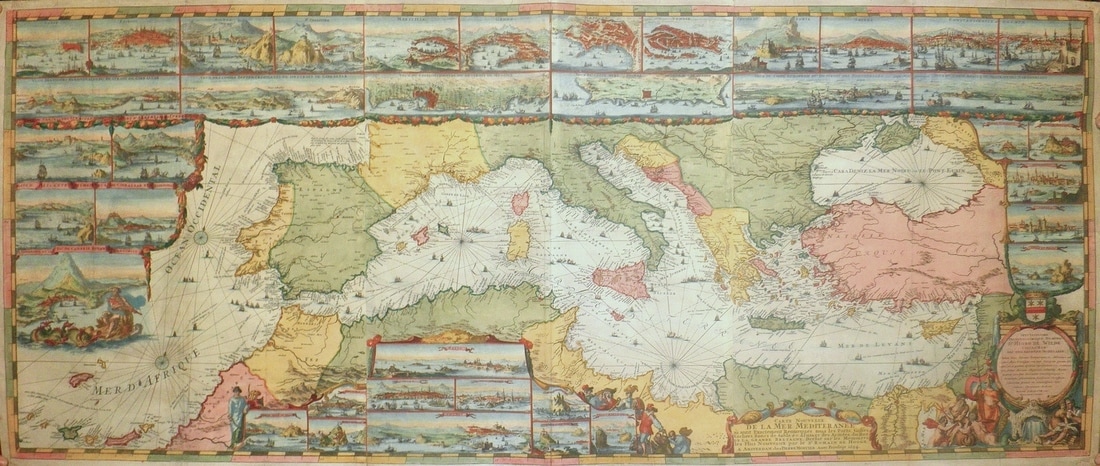
Concepts such as Social Network Analysis (SNA), spatial mapping, and connectivity offer stimulating new resources for the academic analysis of political, economic, and cultural contacts in historical contexts. Moreover, the great diversity of populations, traditions and religions around the pre-modern Mediterranean provides an ideal, multi-faceted laboratory for the application of these new theories. How did networks of cities, ports, religious centers, colonies, diaspora-communities, diplomats, Grand Tour travellers, or letter-writers contribute to the construction of Mediterranean communities and Mediterranean worlds? What role did the sea itself play in the rise and maintenance of these networks? How and by what means can we best map these networks across the "Blue Web"? 

Picture

​BLUE NETWORKS
​SOCIAL NETWORKING IN THE PRE-MODERN WORLD


Over the past century, the field of Mediterranean Studies has been dominated by two paradigms: the bifurcated Mediterranean of the battlefield, and the bustling, connected Mediterranean of the bazaar -- as historian Eric Dursteler has alliteratively phrased it in a recent review article. This latter paradigm of connectivity and exchange has a long history that is closely connected with historian Fernand Braudel's 1949 masterpiece La Méditerranée et le monde Méditerranéen a l'époque de Philippe II [English translation by Sian Reynolds, 1972]. For Braudel, the pre-modern Mediterranean was above all characterized by a fundamental unity and coherence: thanks to a ceaseless circulation of people and goods, ideas or armies, religious ideas or languages, the lands surrounding the sea 'lived and breathed with the same rhythms'. The unity of the Mediterranean was, for Braudel, built upon a dense network ('réseaux') of these connections, both regular and casual, which constituted the 'life-giving bloodstream of the Mediterranean region'.
​
The pre-modern Mediterranean can be seen to have functioned as a space of common meanings and means of exchange, connection, encounter, interaction, and accomodation, albeit in different ways and to different degrees across the centuries. Globalization, the decline of the nation-state paradigm, the rise of the World Wide Web, and the ascent of social networks like Facebook have drawn more attention in recent years to these sorts of 'middle grounds' (to cite Richard White's 1991 study of overlapping and interacting Native American and European worlds around the North American Great Lakes in the 17th and 18th centuries). In 2000, Peregrine Horden and Nicholas Purcell helped revitalize the study of this connected Mediterranean 'middle ground' with their magnum opus, The Corrupting Sea. Their work, like Braudel's, traces dense networks of interaction emerging from the circulation and movement of people, ideas, technologies, and goods, often on a very local scale. This constitutes the background-noise of what they label Mediterranean 'connectivity'.

The past decade-and-a-half has seen a rich and growing literature on Mediterranean connectivity, including an influential 2007 issue of the Mediterranean Historical Review curated by Irad Malkin and dedicated to applications of network theory in the archaic Mediterranean. Works such as S.D. Goitein's A Mediterranean Society (1967-85) or Jessica Goldberg's 2012 study, both of which mined the correspondence and documents of medieval Jewish traders discovered in the Cairo Geniza at the end of the 19th century; Giovanni Ruffini's 2008 mapping of social networks in Byzantine Egypt; Francesca Trivellato's examination of Livorno-based Sephardic trading networks in Goa; or Natalie Rothman's and Eric Dursteler's studies of interpreters, converts, and renegades, all reveal these sorts of connectivities in practice across the Mediterranean -- and beyond, reaching deep into the Atlantic or Indian Oceans. These networks-in-practice point to the important roles of colonizers, textual communities, and diaspora communities in connecting the sea and its surrounding lands and peoples.

This course asked how we, as students of the pre-modern Mediterranean, can move from chiefly descriptive approaches of connectivity to using networks as a tool of analysis. In the field of historical Social Network Analysis (SNA), a social relation is anything that links or is shared by two or more interacting units. This link can consist of personal relations, such as kinship, friendship, patronage, or co-membership, or a good, a debt, an artistic style, or a correspondence. These links can reveal a great deal about how networks form and function, how they are sustained, how proximity or distance affect their development and growth, how they affect individuals, societies, and communities, or how different networks interact with each other. Analyzing networks asks us to shift from the study of individuals and states to the study of social relationships, patterns of connection, systems of relations, and processes (such as how patterns of relations and transactions can affect individual behaviors or historical systems, or how resources, ideas, services, goods, risks, or information can flow through relations, and in what ways). Studying networks and relations can reveal and highlight histories of interaction and interconnection, and can help us to understand how the Mediterranean world as we know it today came about.  ––– MKW
For more on the course, see the About page ...
Picture
Course Instructors:
Antiquity: Dr. C.G. Williamson
Medieval: Dr. A. van Steensel
Early Modern: Dr. A. Singh, Dr. M.K. Williams
contact: [email protected]
Powered by Create your own unique website with customizable templates.